User publications Q3 2026: Taming toxins, tuning sodium channels and unravelling rare diseases
Q3 2026 delivered another eclectic assortment of ion channel science, spanning natural antidotes, neuronal excitability, safer drug discovery and rare blood disorders. Once again, small ionic currents carry substantial biological consequences.
We have selected the following studies to highlight:
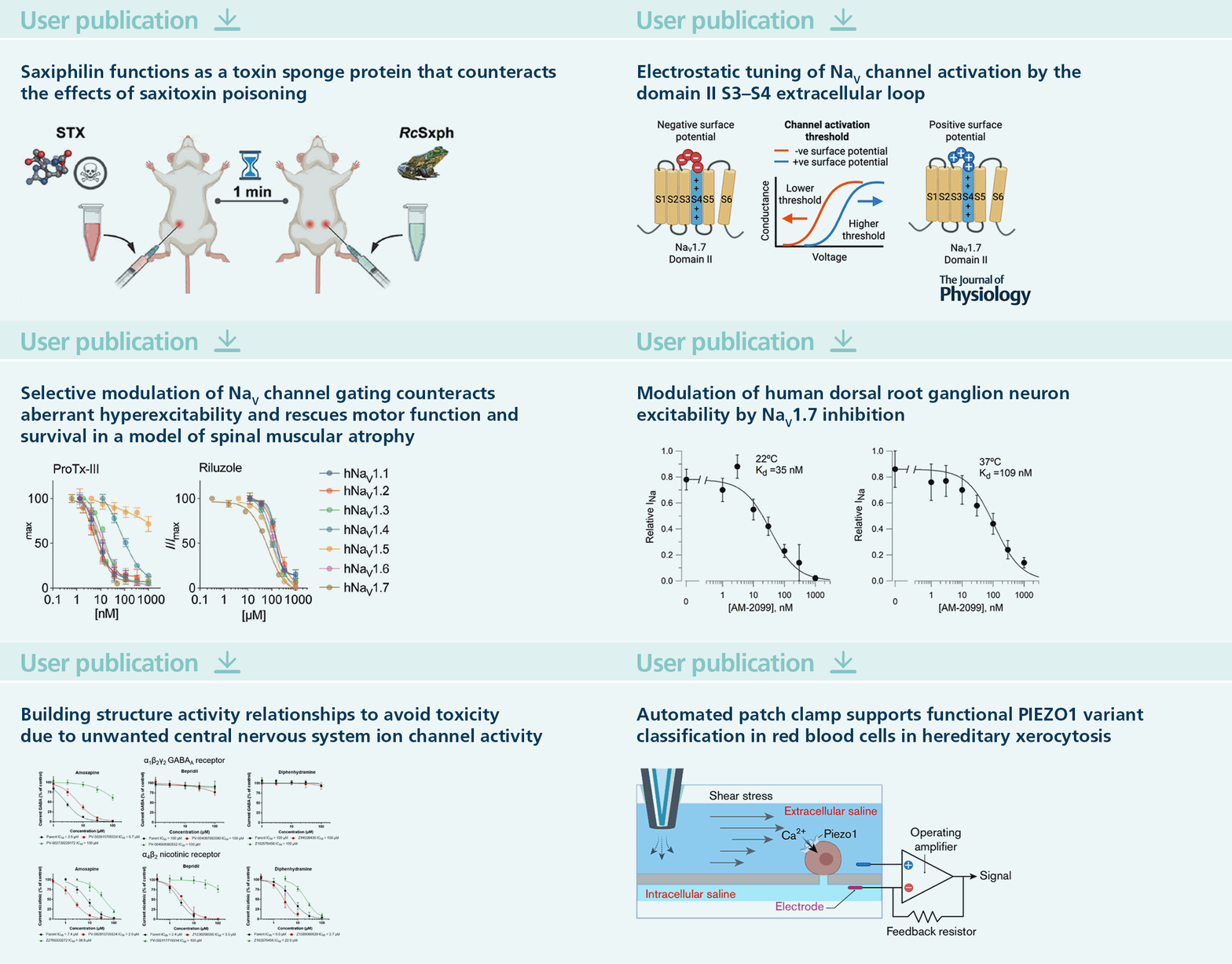
- Nixon et al. borrowed from nature’s molecular ingenuity, demonstrating how saxiphilin, a frog-derived toxin-binding protein, neutralises saxitoxin and protects voltage-gated sodium channels from inhibition. Sophion’s automated patch clamp helped demonstrate its antidotal potential.
- Fujita et al., from Prof. Bruce Bean’s laboratory at Harvard Medical School, explored how NaV1.7 inhibition modulates human dorsal root ganglion neuron excitability, offering fresh insights into the complex electrophysiology underpinning pain signalling.
- Thapa et al. and Cardoso et al., University of Queensland, explored voltage-gated sodium channel behaviour from complementary perspectives. Thapa et al. unravelled how electrostatic interactions fine-tune NaV activation, while Cardoso et al. demonstrated how selective NaV modulation can counteract neuronal hyperexcitability and improve motor function in spinal muscular atrophy.
- Zolkiewski et al. tackled unwanted central nervous system ion channel activity, developing structure–activity relationships to identify and mitigate off-target toxicity. A timely reminder that good drug discovery involves knowing which channels not to modulate.
- Haseli et al., from University of Copenhagen and working with Sophion, brought automated patch clamp into the world of red blood cells, demonstrating how functional PIEZO1 recordings can help classify genetic variants associated with hereditary xerocytosis. A compelling marriage of electrophysiology, genetics and clinical relevance.
Congratulations to all authors contributing to this quarter’s research.