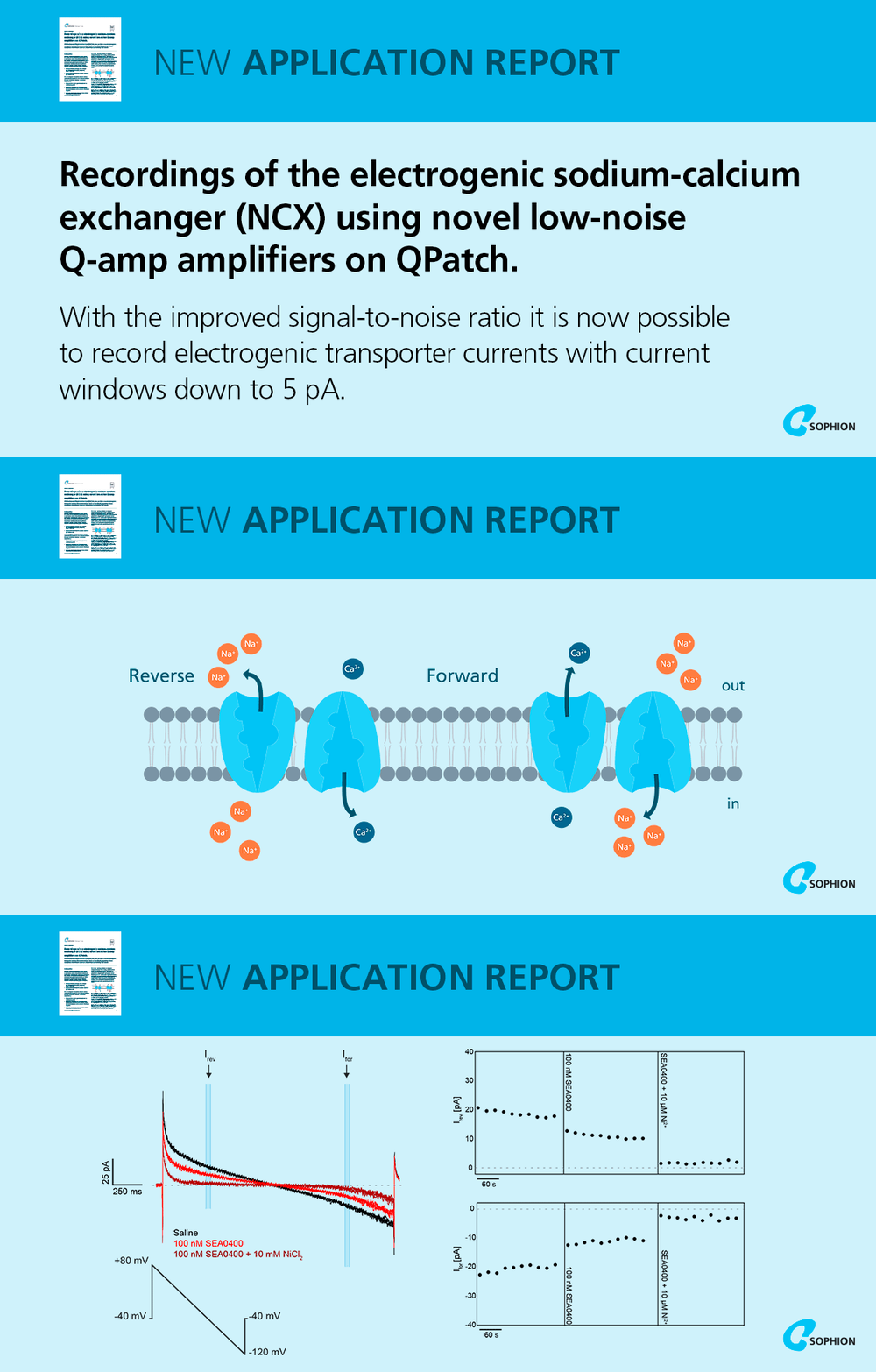
New Application Report demonstrates robust NCX pharmacology through improved signal resolution
Electrogenic transporters such as the sodium-calcium exchangers NCX1 and NCX2 are challenging targets for electrophysiological investigation due to their small current amplitudes. In this application report, we demonstrate how Sophion’s low-noise Q-amp amplifier improves signal resolution on QPatch, enabling reliable transporter current recordings down to 5 pA and robust pharmacological characterization of NCX compounds.
Expanding the reach of automated patch clamp for transporter research
Transporter recordings occupy an awkward but important corner of electrophysiology: slower than ion channels, smaller in amplitude, and often just shy of comfortable, consistent detection.
The ability to reliably resolve low-amplitude transporter currents opens new opportunities for pharmacological characterization using automated patch clamp. This application report highlights a reliable workflow for measuring low-amplitude NCX1 and NCX2. Using NCX tool compounds ORM10103 and SEA0400, we show how improved signal resolution supports non-cumulative concentration-response experiments and the generation of robust IC₅₀ values. These capabilities enable more reliable compound profiling while reducing uncertainty associated with low-amplitude transporter measurements, helping extend the reach of automated patch clamp into challenging transporter applications.
Transporter recordings with clearer pharmacology
The assay presented here captures NCX current in both forward and reverse directions, whilst combining stringent quality control filters with low-noise to help keep the measurements clean and ensure high-quality data. Whole-cell success rates exceeded 80%, with NCX current detection achieved in 32% of NCX1 and 39% of NCX2 recordings.
Beyond demonstrating assay robustness, these results highlight a practical and scalable approach to transporter research. By enabling reliable characterization of low-amplitude currents, the workflow supports compound profiling, mechanism-of-action studies, and cardiac safety assessment, helping bring challenging transporter targets within reach of automated patch clamp.
From signal detection to meaningful pharmacology
When studying electrogenic transporters, even a few picoamps can make the difference between inconclusive data and actionable results. By reducing noise and improving assay performance, researchers can generate cleaner data, increase confidence in compound characterization, and obtain more reliable pharmacological parameters.
The ability to accurately resolve low-amplitude NCX currents enables robust concentration-response analysis and supports more informed decision-making in transporter research and drug discovery. Read the application report to explore how Q-amp and QPatch are expanding the possibilities for automated electrophysiological investigation of challenging transporter targets.