QPatch Compact Instrument Grant advances pain and neuroscience research at UCSD
Assistant Professor Kim Dore at the University of California San Diego, US, has been awarded a QPatch Compact instrument grant. As human-relevant neuronal models open new avenues for studying pain and neurological disease, we spoke with Dr. Dore about how automated patch clamp is helping her lab uncover the functional biology of sensory neurons and accelerate neuroscience research.
Q: Could you give some background on these iPSC-DRGs?
HD10.6 cells are an immortalized human dorsal root ganglion (DRG) cell line derived from embryonic sensory neuron tissue. In their undifferentiated state, they are proliferative, but under appropriate differentiation conditions they develop many features of sensory neurons, including a nociceptor-like phenotype, making them a useful human model of DRG function. They originated from human embryonic dorsal root ganglion tissue and were originally developed and widely used in the herpes simplex virus (HSV) field because they retain key sensory neuron characteristics that support studies of viral latency and reactivation. More recently, the model has been adopted by the pain research community because it can be differentiated toward a nociceptor-like phenotype and provides a renewable, human-relevant system for studying sensory neuron excitability and mechanisms of pain.
The value of this system is that it gives us a renewable, human-relevant platform for studying sensory neuron excitability. We have been characterizing the cells across multiple levels: marker expression, morphology, calcium responses, MEA activity, and direct ion-channel physiology using manual patch clamp. Our next step is to adapt these assays to automated patch clamp so that we can scale data collection, improve accessibility, and enable more standardized electrophysiological profiling across experiments and collaborators.
Q: Can you walk us through the first set of ion-channel assays you plan to run on the QPatch Compact?
The first assays we will run are establishing the baseline electrophysiological profile of the HD10.6 cells, beginning with voltage-gated sodium channel currents, because sodium conductance is central to nociceptor excitability and highly relevant to pain biology. We will start with total sodium current density, activation and inactivation curves, recovery from inactivation, and sensitivity to subtype-selective pharmacology where possible. We also plan to evaluate the effects of a Nav1.7-targeting AAV that we have already validated as effectively depleting Nav1.7 RNA. Using automated patch clamp, we can directly test how reducing Nav1.7 expression alters sodium currents and overall excitability in this human sensory neuron model. More specifically, we want to determine whether the AAV can reverse excitability phenotypes induced by disease-relevant perturbations, such as inflammatory soup or client-derived samples, providing an important functional validation of the gene therapy approach.
The novel insight is that we can move beyond asking, “Do these cells look like sensory neurons?” and start asking, “What is the functional ion-channel fingerprint of this model, how variable is it, and how does it change after disease-relevant exposures or targeted interventions such as Nav1.7 knockdown?”
Q: How will automating patch-clamp screening change scale, speed, and reproducibility?
Manual patch clamp is incredibly informative, but it is low-throughput, operator-dependent, and difficult to scale across differentiation batches, patient biofluids, time points, and drug conditions. Automating patch clamp on the QPatch Compact would let us generate direct electrophysiological data at a scale that is much more compatible with systematic model characterization.
Instead of only collecting a small number of manual recordings, we could compare many more conditions in a standardized way: untreated versus treated cells, different differentiation stages, disease-relevant biofluid exposures, and pharmacologic interventions. That gives us better statistical power, better batch-to-batch comparisons, and more reproducible assay development. Most importantly, it lets direct ion-channel physiology become part of the screening workflow rather than a rare validation endpoint.
Q: Where do you see these DRG model neurons being used?
I see these HD10.6 cells being useful in several areas. First, pain drug discovery: especially for screening compounds that target sensory neuron excitability, sodium channels, potassium channels, calcium channels, or inflammatory sensitization pathways.
Second, disease modeling: we can expose these cells to patient CSF, serum, inflammatory mediators, viral proteins, or disease-associated factors and ask whether they induce a hyperexcitable nociceptor-like state.
Third, translational biomarker work: if patient-derived biofluids produce measurable changes in excitability, we can ask whether those changes correlate with clinical pain phenotypes. And finally, mechanism discovery: the model could help identify whether disease-associated pain states are driven by altered ion-channel function, membrane excitability, inflammatory signaling, lipid raft biology, or other cellular mechanisms.
Q: What studies will your collaborators use this system for?
This project using the HD10.6 cells is a collaboration with Tony Yaksh’ lab and his postdoctoral scientist Sara Dochnal. After the initial characterization of the cells described above, she plans to use the system to study HIV-associated distal sensory polyneuropathy (HIV-DSP) by using biofluids from individuals with painful HIV-DSP and assess if they lead to distinct electrophysiological signatures in HD10.6 cells compared with samples from patients without neuropathic pain, and whether those changes correlate with clinical measures of pain severity and sensory dysfunction.
We also plan to use the QPatch Compact system in the context of our own research, which aims to understand sex differences in synaptic plasticity and Alzheimer’s disease. Specifically, we will study glutamatergic ion-channels (AMPA and NMDA receptors) currents in primary neuronal cultures made from male or female WT or AD model mice. Our research suggests that only female AD model mice have deficits in synaptic protein palmitoylation; we hope to use the QPatch Compact instrument to understand the molecular mechanisms underlying this sex difference.
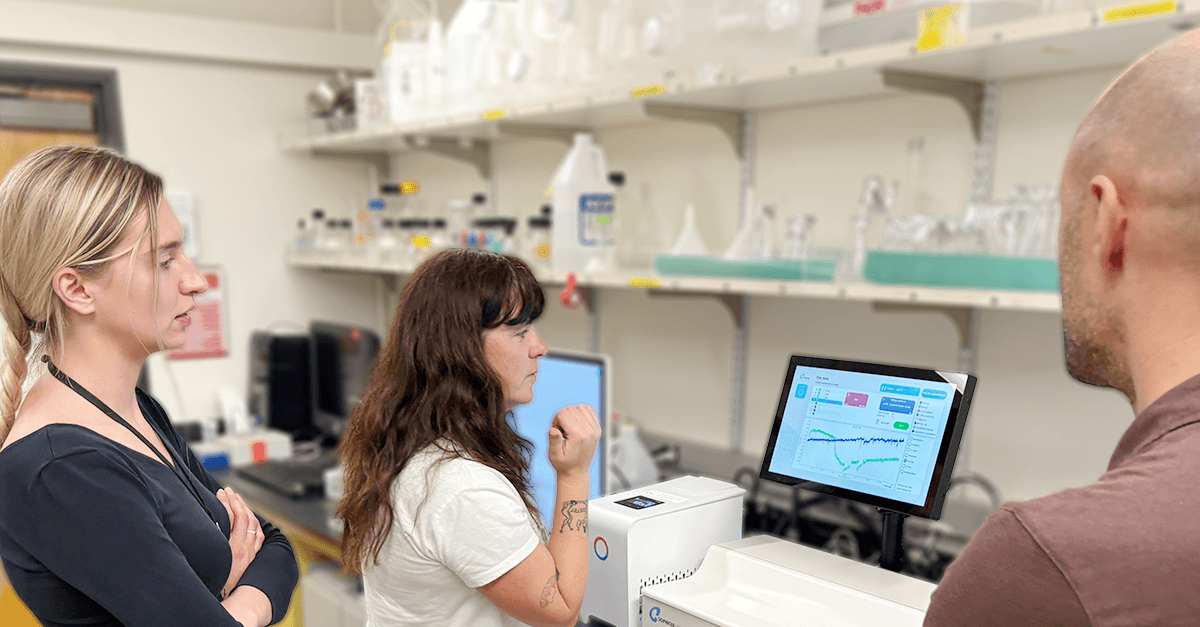
Q: What collaborations have emerged or could emerge from access to automated patch clamp?
Access to automated patch clamp makes this system much more attractive as a shared platform. The combination of the QPatch Compact and the HD10.6 cells gives us a way to offer collaborators something very concrete: a reproducible, human-relevant assay for measuring how disease-relevant exposures alter sensory neuron ion-channel function. Internally, it could support collaborations with pain clinicians, neurologists, electrophysiology groups, stem cell/modeling groups, and drug discovery cores.
Externally, we envision partnerships with groups studying neuropathy, HIV-associated pain, chemotherapy-induced neuropathy, diabetic neuropathy, and ion-channel pharmacology.
Regarding the use of the QPatch Compact instrument with primary DRG or cortical neurons, collaborations with other UCSD labs doing fundamental ion channel research are expected.
Would you like to take your lab’s research further with a Sophion Instrument Grant?