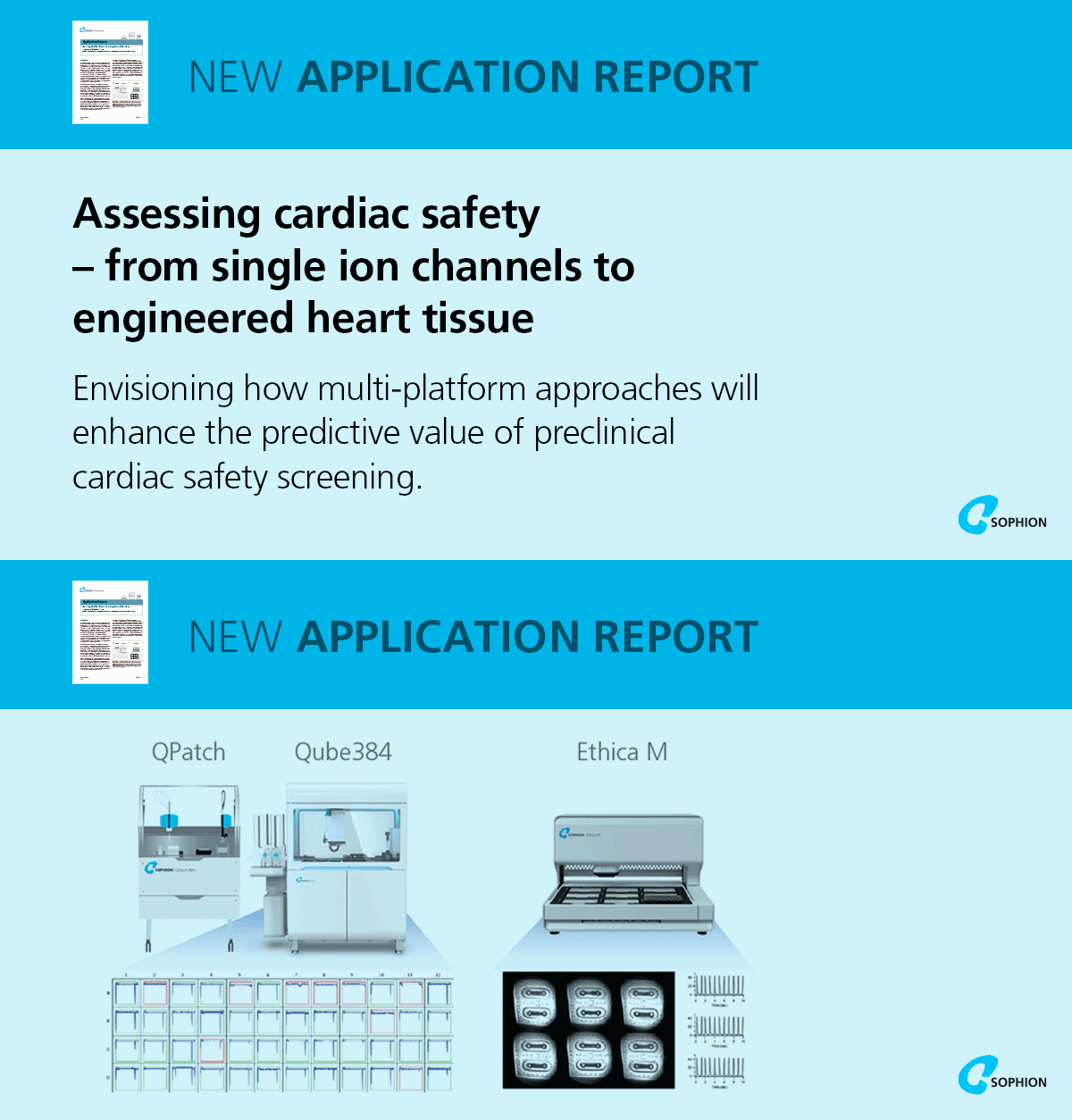
New Application Report describes how multi-platform approaches bridging ion channel electrophysiology and engineered heart tissues redefine translational cardiac safety
Cardiac ion channels such as Nav1.5, Cav1.2 and hERG are central determinants of electrical activity in cardiomyocytes, yet their cellular readouts alone do not fully predict functional outcomes at the tissue level. In this application note, we exemplify how different generic pharmacological compounds with known impact on cardiac ion channels can be evaluated at different scales combining automated patch clamp in hiPSC-derived cardiomyocytes with engineered heart tissue assays. Using this strategy, it will be possible to directly link ion channel modulation to action potential dynamics and contractile function under physiologically relevant conditions.
Cardiac safety: from ion channels to tissue contractility
Cardiac safety rarely fails for lack of data; it fails for lack of context and translation from the molecular to tissue. Ion channel assays tell you what a compound does. Tissue assays tell you what that means. The gap between the two is where uncertainty lives. This Sophion application report describes how we close that gap.
Integrated insights into cardiac safety across scales
Our scientist brings together automated patch clamp (APC) and engineered heart tissue (EHT) assays to assess cardiac safety from single ion channels through to contractile function. At the cellular level, APC captures detailed electrophysiology in hiPSC-derived cardiomyocytes, resolving currents such as Nav1.5, Cav1.2 and hERG, linking them to action potential dynamics. At the tissue level, EHT assays translate those signals into force, rate and contraction.
Individually, each assay is powerful. Together, they are far more informative.
Cardiac safety when ion channels shape contraction
The value lies in the context:
- Block Nav1.5 and conduction slows; contractility falls.
- Modulate Cav1.2 and action potentials shift; force follows.
- Inhibit hERG and repolarisation prolongs; tissue dynamics change.
The same compound, traced from ion channel to beating tissue, reveals not just effect, but physiological response and consequence.
A more predictive view of cardiac risk
Traditional cardiac safety screening often isolates endpoints. Electrophysiology without mechanics. Contractility without mechanism. This multimodal approach integrates both. The result is a more predictive, mechanistically grounded view of cardiac risk, better aligned and translational with human physiology, and better suited to decision-making in drug discovery.
Click to explore the full application report and discover how integrated assays are reshaping cardiac safety from single currents to beating tissue contractility.