New application report demonstrates functional characterization of PIEZO1 variants in red blood cells
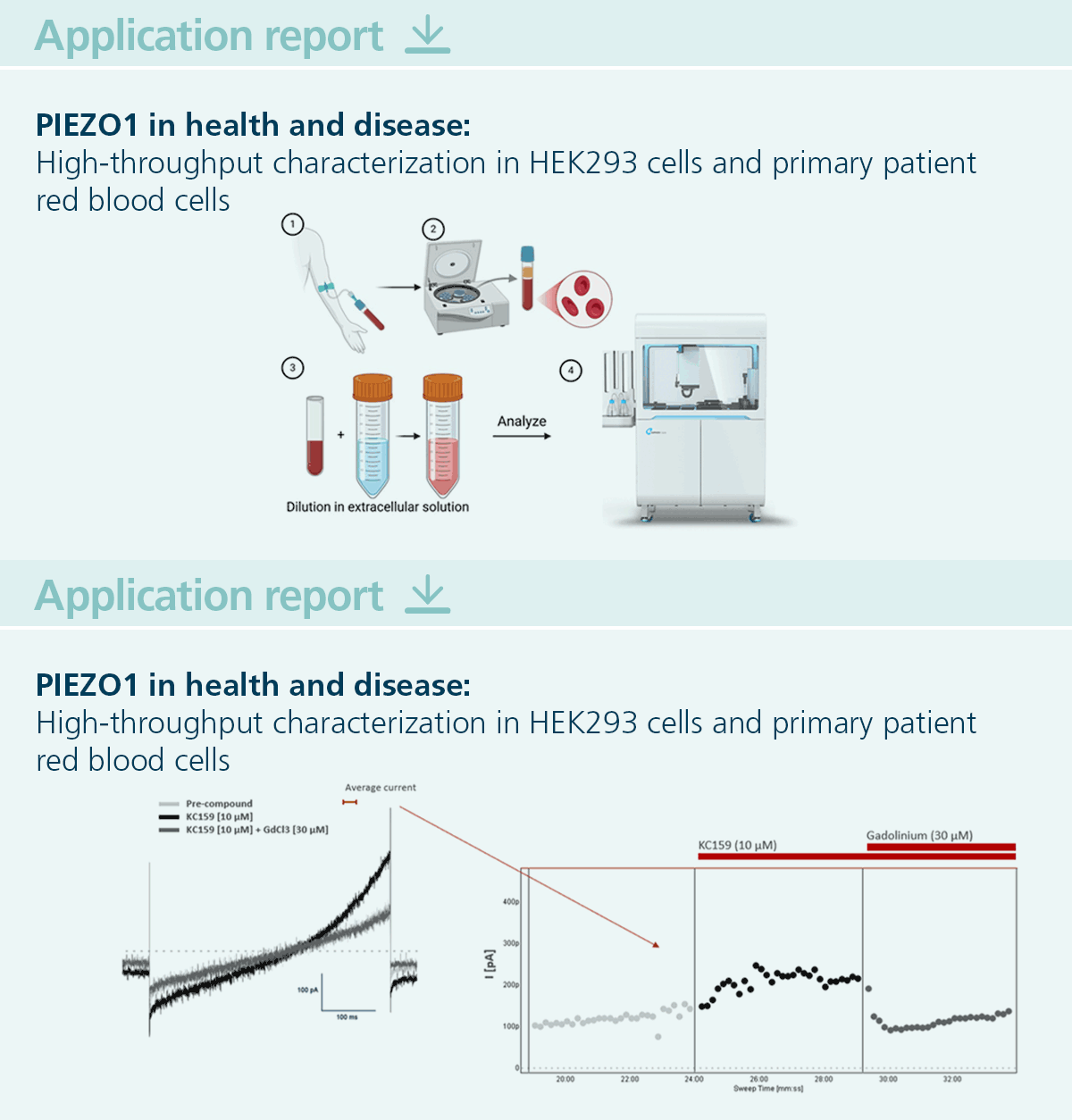
PIEZO1 plays a critical role in how red blood cells respond to mechanical forces while maintaining their ionic balance. Gain-of-function mutations can prolong channel activation, leading to excessive calcium influx, potassium loss, and red blood cell dehydration associated with hereditary xerocytosis. In this application report, we demonstrate how automated patch clamp on Qube 384, combined with controlled microfluidic shear stress and high-resistance (HiR) QChips, enables functional investigation of PIEZO1 in recombinant HEK293 cells and native human red blood cells.
Connecting mechanical stimulation to PIEZO1 function
Distinguishing pathogenic PIEZO1 mutations from innocuous variants remains challenging. Functional characterization can provide important insight into how individual variants affect channel behaviour and help link genetic findings to disease-relevant phenotypes.
The workflow presented here combines mechanical stimulation, electrophysiology and pharmacology to characterize PIEZO1 channel function. Controlled microfluidic flow provides physiologically relevant mechanical stimulation, while HiR QChips support stable recordings from delicate red blood cells.
By bringing these capabilities together on Qube 384, the approach enables PIEZO1 to be studied across recombinant cell models and patient-derived material, providing a scalable route from genetic variant to functional assessment.
Distinguishing pathogenic from benign variants
The assay integrates mechanical stimulation, electrophysiology and pharmacology to characterise channel kinetics and function.
Patient-derived red blood cells carrying the pathogenic R2456H variant exhibited approximately eightfold greater PIEZO1 currents than healthy controls. In contrast, the G909V variant displayed a control-like profile, highlighting the assay’s ability to distinguish functional phenotypes.
HiR QChips facilitate stable recordings from delicate red blood cells, while controlled microfluidic flow recreates physiologically relevant mechanical stimulation.
These distinct responses demonstrate how electrophysiological measurements can help differentiate disease-associated PIEZO1 dysfunction from variants with a benign functional phenotype. Importantly, the workflow enables these differences to be investigated directly in native red blood cells while retaining the control and scalability of automated patch clamp.
From mechanosensation to disease insights
Understanding how PIEZO1 variants alter channel function can provide valuable insight into the mechanisms underlying hereditary xerocytosis and support interpretation of genetic variants.
By bridging recombinant assays with patient-derived cells, this high-throughput approach offers valuable opportunities for investigating PIEZO1 dysfunction, interpreting genetic variants, and advancing rare disease research.
Discover how Qube 384 and HiR QChips enable functional characterization of PIEZO1 and help bring disease-associated variants into sharper focus. Read the full application report.