QPatch Compact is set to accelerate multi-lab ion channel research and collaboration
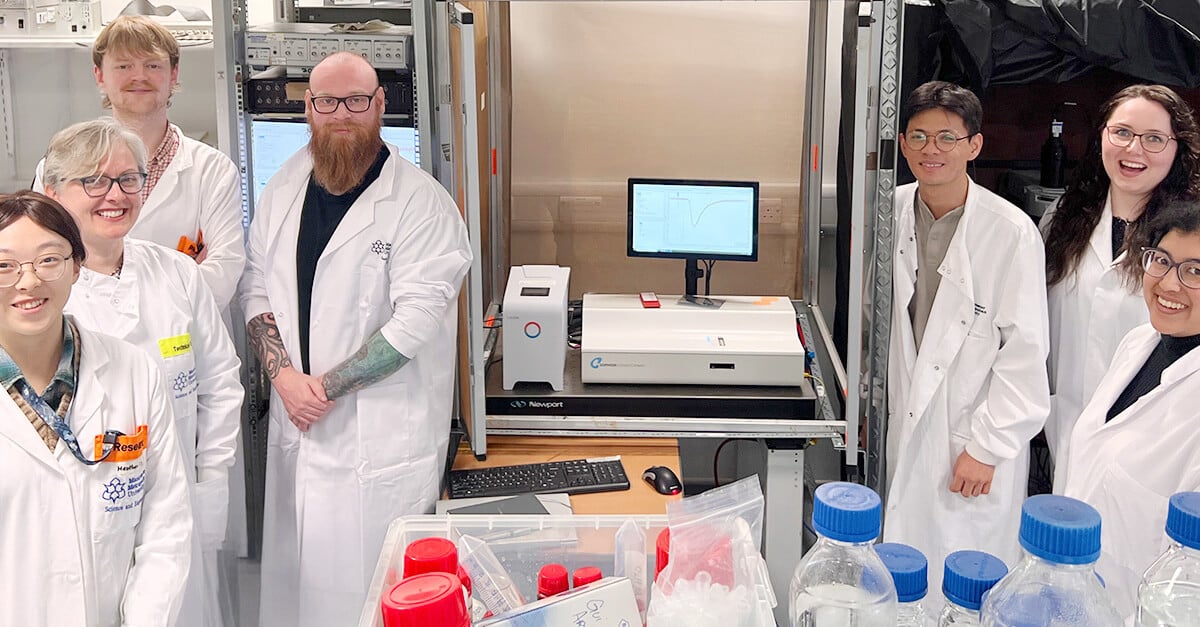
Dr. Fred Jones and his team at Manchester Metropolitan University in the UK have been awarded a QPatch Compact instrument grant. We spoke with Dr. Jones about the award and how access to Sophion’s automated patch clamp technology will allow his group to scale up ion channel assays across a range of cell types, opening new possibilities for studies that were previously out of reach.
Q: It’s still early days, but how has the installation, training, and working with Sophion gone so far?
Working with Sophion is always a great experience for me; the technical team are very knowledgeable about patch clamp and just as excited when we successfully troubleshoot an issue. The installation is very easy, and the instructions provided are easy to follow. It doesn’t feel like a piece of equipment you have to leave rooted in place due to a complicated install, which I think is a nice feature.
We did the install and training over two days with multiple labs attending within the university and from York, so there was a large group of us with varying patch clamp experience. Yet the days were engaging, there were people learning the equipment for the first time, and it was useful to refresh for me, too. There were a number of occasions where I realized learned something I had missed previously.
Q: Your lab has worked on a QPatch Compact previously. With this 2nd bite of the cherry, can you walk us through this next phase of cancer ion-channel assays you plan to run?
We have lots of varied plans with a number of different cell types, including cancer cells, cardiovascular, neuronal and smooth muscle. The primary focus is on the voltage-dependent ion channels involved in cancer development and the mechanisms regulating their expression and function. Thus, our assays require manipulating intracellular mechanisms and recording channel changes in the cell along with pharmacological tools to confirm the identity of the channels driving the current. Excitingly, we are also keen to begin tracking membrane potential changes in various cell types, this is a great feature on the QPC that we are beginning to find very useful to do current clamp in this way in a high-throughput manner.
Q: How will automating patch-clamp screening on the QPatch Compact change the scale, speed, and reproducibility of your preclinical assays compared to your current manual methods?
Due to the nature of the research being conducted here, we are generating big expression data and modelling that result in large numbers of possible candidates responsible for the voltage-dependent properties of the cell. The automated capability allows us to quickly screen with different pharmacological and genetic tools to identify the channels driving the properties. The increased efficiency makes it more feasible to increase the number. With the heterogeneity in the cells we use, including cancer cells, recording from more cells in a shorter time allows us to build a larger profile of that particular cell type. This leads to more accurate observations. I think it is helping to support our manual patch. The eventual goal is to be able to do this screening more efficiently with APC. This would free up time to use manual patch for more specific, detail orientated questions we are less able to approach with APC.
One large benefit I see, is the lower barrier of entry to attaining patch clamp data. We do not have the capacity to support lots of projects through manual patch clamp here. With the QPC, we are able to collect and support data collection of other groups. This allows us to generate patch data for studies that we would not have considered trying otherwise. The training from Sophion had people present from 6 different groups, some of whom are not electrophysiologists by training.
A strength of your application was the multi-lab, even multi-institution, research you hoped to do, with an element of the planned studies being with other labs like Prof. Will Brackenbury at York University.
Q: What studies will your collaborators, and what specific questions in each of their areas of oncology, will you target with this system?
Will and I have overlapping interests in relation to the involvement of ion channels across different cancer types. While our research lies in different cancers there are similarities, particularly in the expression patterns of sodium channels, that has presented an opportunity for us to collaborate on this significant crossover and explore the possible mechanisms.
Q: What new collaborations, within your institution and/or with external partners, have emerged or might emerge as a direct result of having access to Sophion’s automated patch-clamp technology?
We share the vision that a northern England hub for automated electrophysiology would be heavily utilised and are keen to demonstrate that travelling to a central hub is a viable option, even across the Pennines.
This vision and the low barrier of entry for people to be able to complete experiments on the QPC has given rise to a number of further collaborations. We have already set aside time to run experiments on cells within the vasculature, uterine smooth muscle, and glia with labs that otherwise would not have considered patch clamp within their methodology.
Would you like to take your lab’s research further with a Sophion Instrument Grant?