Contractile tissue gets to the ‘heart of the matter’ with Ethica M cardiac safety screening
Our latest application report showcases a fully validated contractility assay using the Ethica M organ-on-a-chip platform. We demonstrate robust generation of 3D engineered human heart tissues (EHTs) in a standard 96-well format. The data confirm that Ethica M-derived tissues behave consistently and sensitively, offering a scalable, human-relevant assay suitable for cardiac safety evaluation and drug screening.
Ethica M brings high-throughput scale to engineered contractile tissue research
Advances in cardiac drug discovery increasingly rely on models that capture the complexity of human physiology. Traditional 2D cultures, while widely used, often fall short when predicting in-human responses. Engineered 3D contractile tissue constructs provide a more functional, physiologically relevant and translatable alternative, and Ethica M has been designed to make these assays practical at scale. Its automated workflow supports consistent tissue casting, reliable optical measurements and integrated pacing in a format suited to industrial discovery and safety programmes.
Why engineered contractile tissue matters for modern drug development
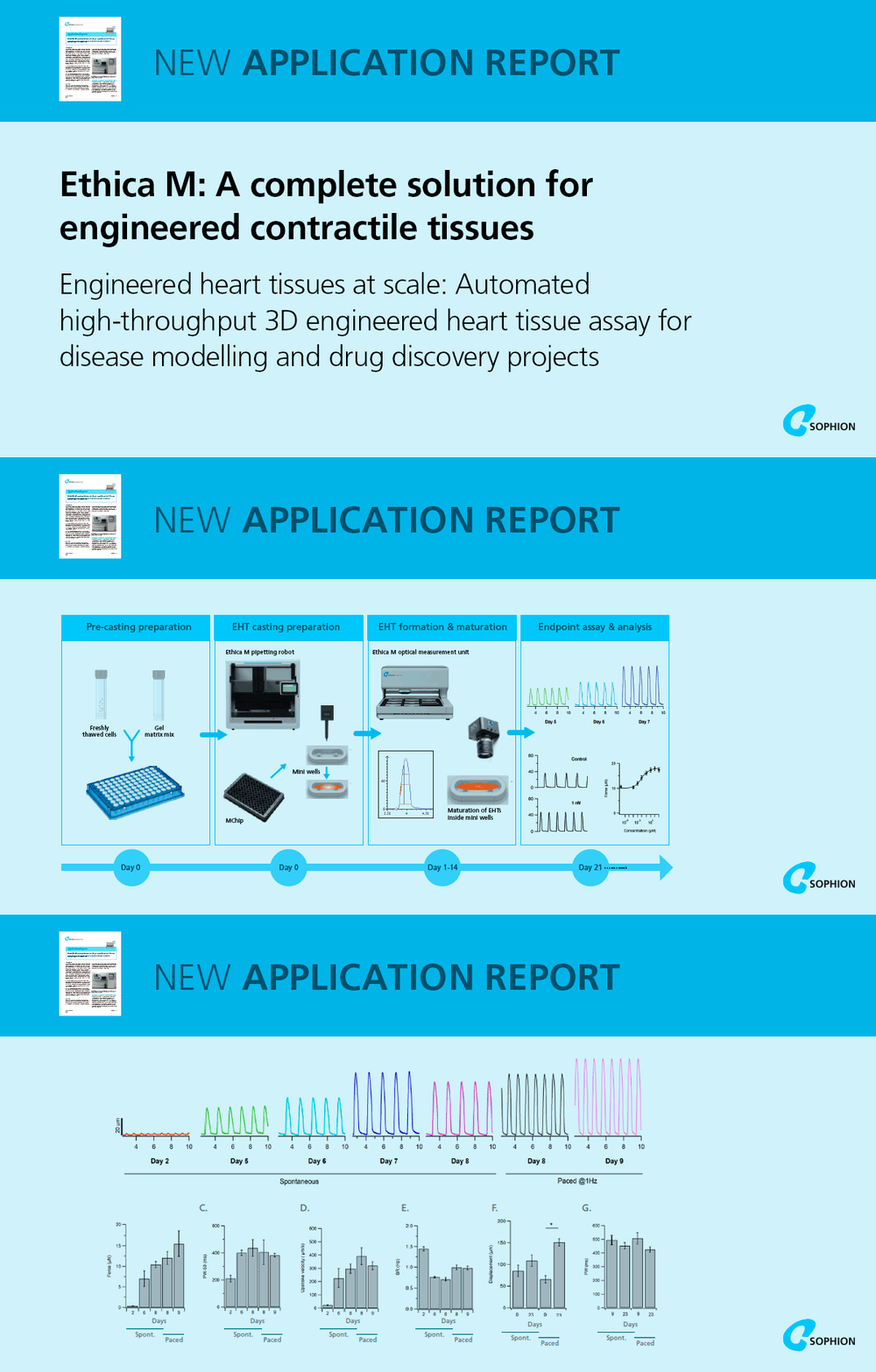
Cardiovascular diseases remain a major global health challenge, and researchers need in vitro systems that better reflect the behaviour of human heart muscle. Ethica M addresses this by forming 3D contractile tissues around flexible pillars in a 96-well MChip. As each tissue contracts, pillars are deflected and these movements are tracked optically to generate force, timing and velocity measurements. Compared with 2D, flat monolayers, these contractile tissue models provide richer, more predictive and translatable data for assessing drug effects, mechanisms and safety liabilities.
Contractile tissue formation and maturation on the platform
Ethica M enables reproducible tissue formation using fewer than 50,000 cells per construct. Over the course of days, tissues compact naturally and begin delivering measurable contractile forces. The system’s optional pacing feature supports further maturation. Introducing steady pacing during culture leads to stronger contractions, narrower pulse widths and tighter regularity than spontaneously beating controls. Because all steps can be automated and scheduled, researchers can culture and monitor many tissues in parallel without extensive hands-on time.
Contractile tissue pharmacology with physiologically meaningful responses
3D tissue constructs generated on Ethica M respond to well-characterised inotropic agents with expected changes in contraction strength, beat frequency and waveform shape. Positive and negative inotropes produce clear concentration-dependent effects, with tissues displaying normal sensitivity to changes in extracellular calcium. This combination of scalability, automation and physiological relevance positions contractile tissue assays as a strong tool for both discovery and cardiac safety assessment.
Take the next step
If you are looking to integrate engineered contractile tissue assays into discovery, disease modelling or safety workflows, consider evaluating how Ethica M could support your programme. The platform offers an efficient solution to more predictive and translatable data, higher throughput and ultimately enhanced confidence in decision-making.
Discover more about Sophion’s human-relevant heart & muscle-on-a-chip solution, Ethica M here